
Self-effacing Northsider becomes face of movement to shut down trash burner

Natasha Villanueva answered questions during a Friday news conference at the Hennepin County Government Center. Villanueva and two others began a hunger strike on Friday to pressure county officials to set a date to close a garbage incinerator. Photo by David Pierini
By David Pierini, Editor
Natasha Villanueva stood behind the circle of people, a position that suits her when she allies with social justice groups.
She prefers the quieter necessities of a movement and is unlikely to get behind a bullhorn or microphone. During the ICE occupation in Minneapolis, she did laundry for families and delivered meals in the Jordan neighborhood where she lives.
But on a crisp Friday morning on the Hennepin County Government Plaza, Villanueva was brought forward to speak.
Villanueva, for the first time, came forward as a face of a movement. Her voice was soft and wobbled with emotion. Someone from the crowd asked her to speak up.
She spoke up.
Villanueva introduced herself as one of three people on a hunger strike to pressure county commissioners to close the aging trash incinerator.
“The trash burner was supposed to run for 20 years, and it has poisoned us for nearly 40,” she said. “My father is a migrant from Guatemala who raised me with the discernment that what is moral does not always correlate to how systems in our society operate, and an obligation to stand with people who live in the margins.
“Today, I am going on a hunger strike, and I did not anticipate feeling this emotional, but it makes sense for the gravity of the situation.”
Villanueva is active with the Zero Burn Coalition, a group of organizations and residents from across the county pressing commissioners to set a date to close what is known as the HERC, shorthand for Hennepin Energy Recovery Center.
Extended shelf life
The HERC opened in 1989 and burns an estimated 1,000 tons of trash each day. Environmentalists say its emissions are responsible for millions of dollars in annual health damages and one to two premature deaths a year from particulate matter.
Northsiders feel particularly vulnerable to HERC and the industrial polluters that have resided along the Mississippi River near North Minneapolis. The Northside has the highest rates of asthma and other respiratory ailments in the state, according to a 2019 study by the Minnesota Pollution Control Agency.
The county says HERC is tested regularly and its emissions meet environmental safety guidelines. Commissioners have vowed to close the trash burner as part of a zero-waste plan. Before the county board can set a date, they say municipalities must bolster recycling and composting efforts, and lawmakers must write new legislation to reduce and reuse waste, including strict rules around packaging materials.
The MPCA says emissions from vehicles traveling along I-94 are the largest source of air pollution, and commissioners say closing the HERC prematurely would increase landfilling and truck traffic.
Audua Pugh, a vocal Zero Burn activist, said landfilling trash may be necessary temporarily to halt the HERC while technology and habits shift toward more aggressive reuse and recycling.

The Hennepin Energy Recovery Center opened in 1989 and was supposed to operate for 20 years. 2023 Photo by David Pierini
“The HERC only burns about a third of the waste in Minnesota,” said Pugh, executive director of the Jordan Area Community Council. “So, the rest of it is being landfilled anyway. Out of the lesser of the two evils, for me, it’s landfilling. With burning, the pollution hits the air so fast (compared to the greenhouse gases originating from a landfill).”
Pugh was diagnosed with breast cancer last year and is in recovery. She has lived surrounded by polluters, and though she can’t prove exposure to pollution is the culprit, “I know what my body is telling me.”
Because of her health, she is unable to participate in the hunger strike but sees Villanueva’s decision as a sacrifice for other Black and Brown people who have lived overburdened with industrial pollution.
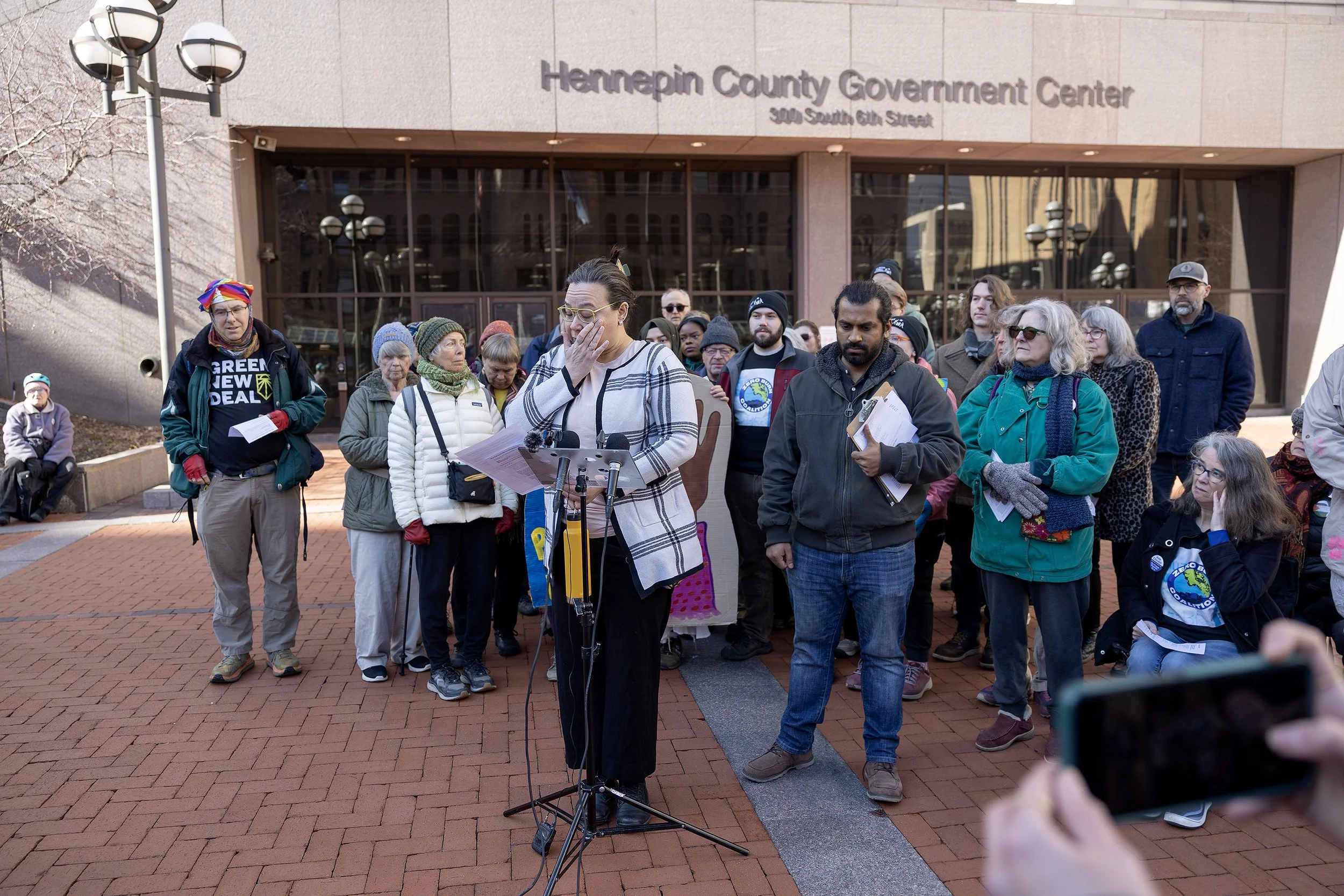
Villanueva was emotional as she spoke of her reasons for joining a hunger strike. Photo by David Pierini
‘Sometimes it takes a flash point’
Villanueva is warm and stands poised with a gentle energy. When she is approached, she often places a hand on her chest, a gesture of respect or gratitude.
On Friday, when Zero Burn activists gathered in the lobby of the Board of Commissioners’ offices, Villanueva stood before a receptionist. While leaders pressed to speak to commissioners or their aides (the office was empty), the receptionist wrote down names and phone numbers while the crowd sang protest songs.
“You’re doing great,” she said, concerned that the receptionist was nervous. “You’ve been so helpful.”
Villanueva spent her childhood in Fargo, N.D., and Warroad near the Canadian border. She grew up around lakes and woodlands in a community that defended the land’s purity from the mining industry.
“My dad instilled in me a lot of values of justice, like the experience of folks who migrate here and the injustice they experience,” she said. “My mother raised me to be very empathetic in general, so I’m very accustomed to being accountable to the community, to de-centering myself and doing what I can to connect. That’s important wherever I live.”
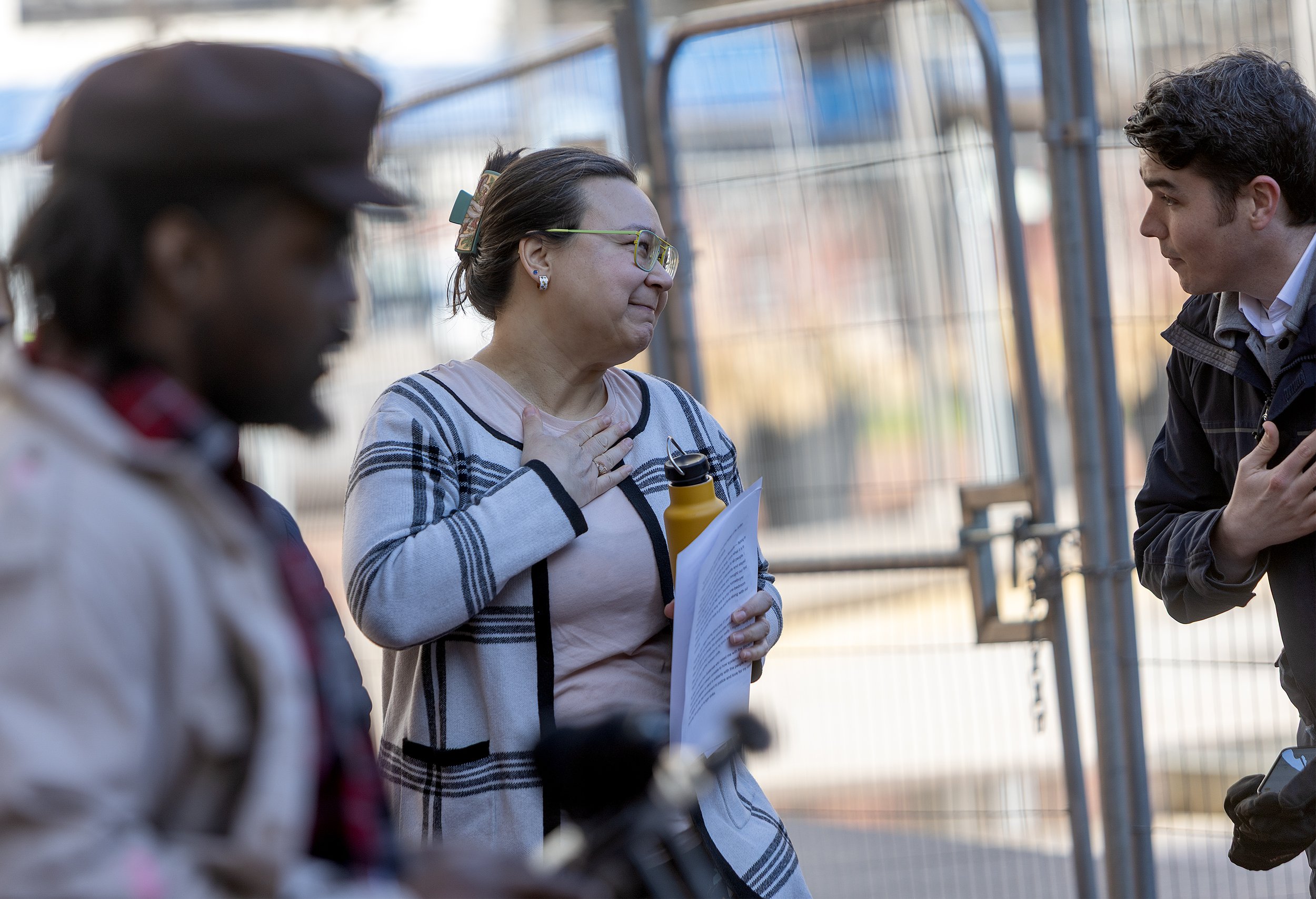
Villanueva tends to play a support role in social justice campaigns. She has become more visible with the Zero Burn Coalition and its efforts to force a shutdown of the HERC. Photo by David Pierini
She moved to Minneapolis to attend college. She has helped organize tenants for renters’ rights campaigns, knocking on doors, securing daycare and making sure there were plenty of signs for demonstrations.
When she and her partner, Julio, whom she met in the Peace Corps, bought their first home in Jordan, she was looking to “plug in” to a new campaign when she learned about the HERC.
She began reading about incinerators, trying to understand the research around air emissions and health impacts. She talked to residents and attended Zero Burn Coalition meetings.
At a coffee shop more than a year ago, she met with Zero Burn organizer Isuru Herath and asked many questions. She shared with him her tendency to resist the more visible roles of activism.
At the government plaza on Friday morning, Herath reflected on Villanueva’s growing awareness.
“I think she has spiritually and morally repositioned herself,” Herath said. “I have seen her really develop a deep consciousness that for this facility to close, there has to be a deeper commitment.”
Herath said Villanueva’s gentle nature helped the coalition and residents get meetings with County Commissioner and Board Chair Irene Fernando, who represents North Minneapolis.

Zero Burn organizer Isuru Herath, right, says he has seen Villanueva’s grow increasingly committed to a public call to closing HERC. Photo by David Pierini
Villaneuva has been “one of the most important liaisons” between the county and the community, he said.
Fernando has not responded to requests for more meetings since the hunger strike was announced. Even as she speaks publicly against Fernando’s silence, she leaves a door open by saying, “I hope to work with Commissioner Fernando” on solutions that meet the county’s zero-waste goals.
Neither Fernando nor her staff responded to multiple requests by North News for comment.

Following Friday’s rally, Villanueva and others made an unannounced visit to the offices of the Hennepin County Board of Commissioners. Commissioners were not in their offices that morning. Photo by David Pierini
Villanueva may feel challenged to remain “decentered.” The very act of a hunger strike places her front and center. But “sometimes it takes something like this, a flash point, to change the course of what we’ve been doing,” she said.
A drastic act of protest
Villanueva, along with Nazir Khan and Joshua Lewis, has agreed to an open-ended hunger strike. They live in a Minneapolis house, where a registered nurse routinely takes vital signs and assesses whether to continue treatment.
Zero Burn has a schedule of daily events, culminating with the public comment time of the April 21st board meeting, when they will again ask board members to set a closure date.
In the past, Fernando has stated she would like to see a shutdown process begin by the end of 2027.

Villanueva hugged Joshua Lewis, one of three who began a hunger strike Friday. Photo by David Pierini
Villanueva is on leave from two jobs for the next two weeks. She said putting “my body on the line” is a way to express urgency. Commissioners, including Fernando, have noted the passion as admirable but said in early April that a hunger strike won’t bring a vote to set a closure date any sooner.
Villanueva and the others will drink water to keep obvious risks at bay. Experts say a person can go without eating for a month or two with varying results. She will listen to her body and what the medical team tells her.
“My goal is not to be combative with the county at all,” she said. “We’ve tried so many times to reach out. Because that hasn’t resulted in success. We have to try this other approach.”