
MPS plan identifies four Northside schools for possible closure
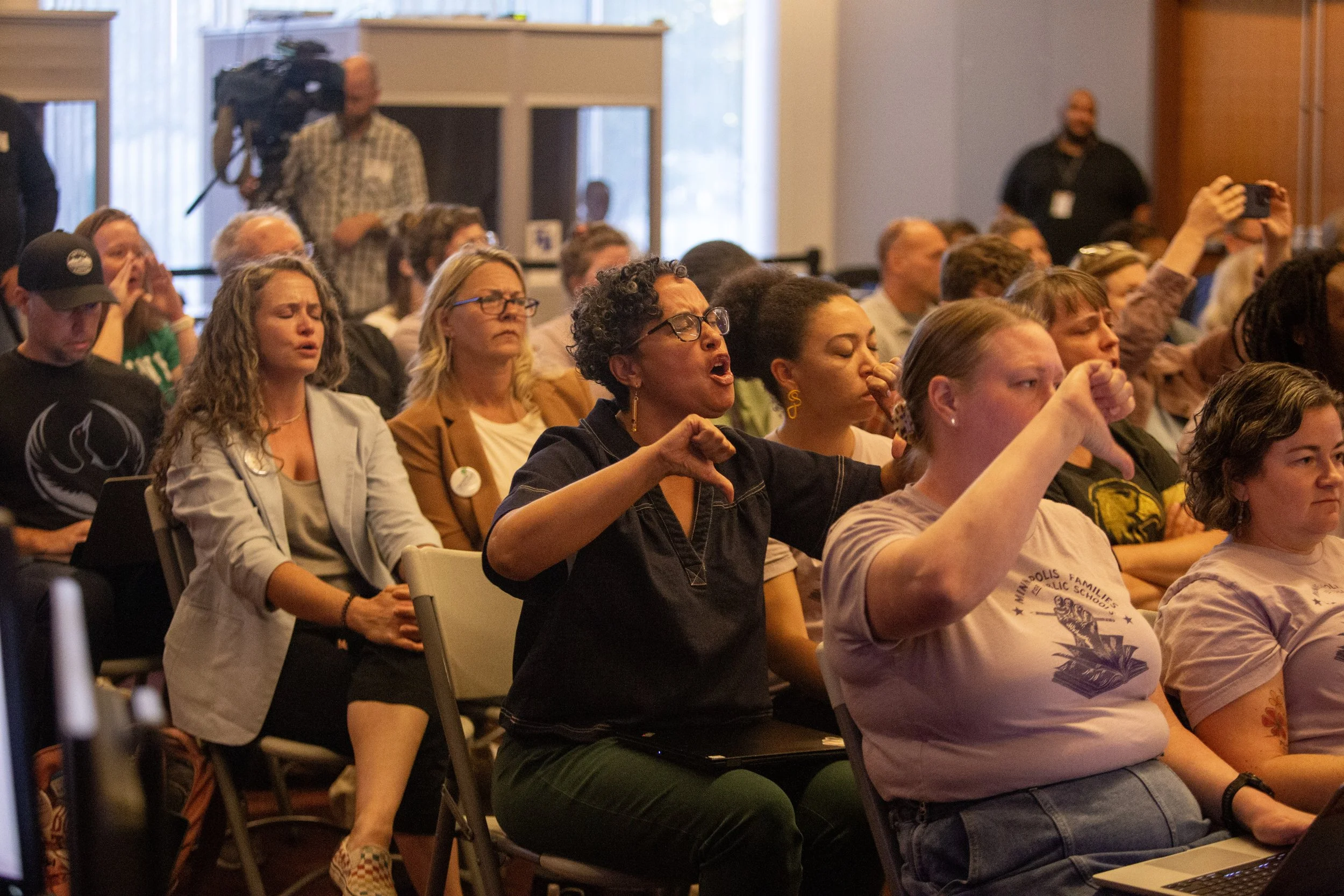
School board candidate Shannon Gibney gave a thumbs-down in response to the Minneapolis Public Schools “school transformation” presentation that involves the potential closures of 16 MPS schools at a school board meeting on Sept. 15. Photo by Azhae’la Hanson
By Azhae’la Hanson, Asst. Editor
considering closing four Northside schools and changing attendance boundaries under recommendations presented by administrators at a school board work meeting on Sept. 15.
The plan took three years to develop after the MPS school board passed a resolution in 2023 directing administrators to present options to consolidate school buildings to address the district's ongoing budget crisis.
Sixteen schools across the district are on the chopping block as administrators try to address underenrolled buildings in what they call “school transformation.”
Administrators also provided a timeline of community engagement through Oct. 10 and are suggesting the school board vote on a building consolidation plan by Nov. 10.
Community engagement meetings will be held at Camden High School on Sept. 30 from 6-7:30 p.m and at North High School on Oct. 7 from 6-7:30 p.m.
The proposed plan presented on Sept. 15 was a vague jigsaw puzzle from MPS senior leadership and drew heavy criticism from some school board directors for its rushed community engagement timeline and for catching school communities off guard.
The presentation, spanning more than 100 slides, was dense with administrative jargon and didn’t explicitly list which schools could face closure.
Administrators did not use the word “closure” during the presentation.
Leadership presented the transformation plan with three options for each community high school and smaller plans to merge magnet schools. Attendance boundaries will change as some schools close and consolidate.
Four of the 16 MPS schools proposed closing are Northside elementary schools: Academy. (See sidebar for all possible pathway changes for Camden and North high schools).
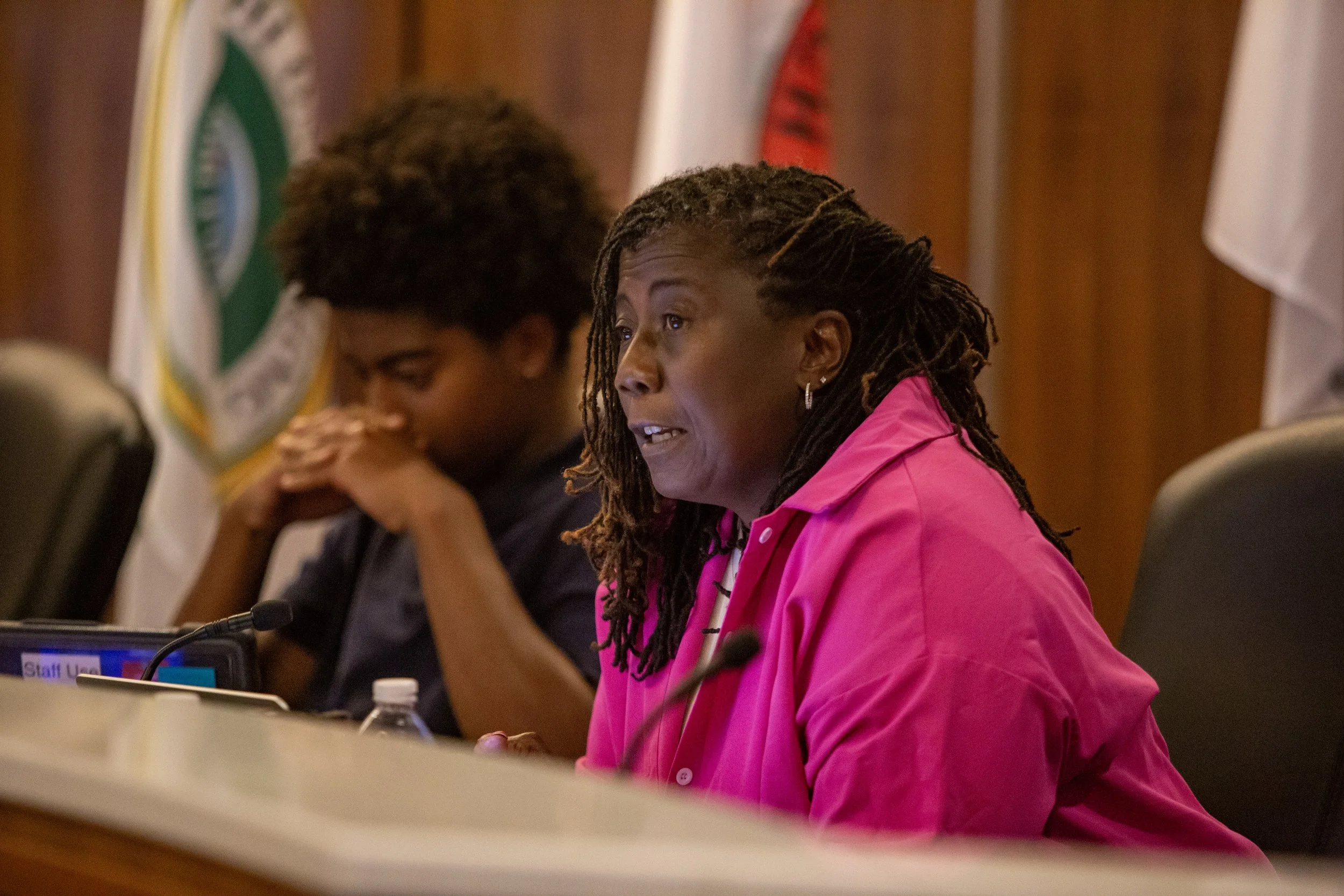
Northside school board Director Sharon El-Amin speaks during the Sept. 15 school meeting and says she wasn’t expecting potential school closures to be announced. Photo by Azhae’la Hanson
School board members react
School board directors and attendees expressed frustration with senior leadership and felt blindsided by the plan.
District 6 Director Greta Callahan criticized the presentation and senior leadership. She said school board members did not receive a clear list of closures before the meeting and were not notified of community engagement opportunities. She called school closures short-sighted.
This is the district's third attempt at restructuring schools and attendance lines since 2007 to correct budget gaps. When the district closed six elementary schools in 2007, five of them were in North Minneapolis.
“In 2007, families left,” Callahan said. “The shuffling and distrust it caused contributed to enrollment dynamics that did not stabilize,” Callahan said. “We have felt this destabilization in every corner of our city, and too much on the Northside.”
With comprehensive district design in 2020, Callahan claimed savings from school closures rarely materialized once enrollment losses were counted.
The current school transformation plan began with the promise of cost savings, too. In 2023, the district estimated it could save about $45 million per year in operating costs by "right-sizing” its physical footprint.
Administrators offered little information on how school closures would help the district’s budget woes during its Sept. 15 presentation, only noting that consolidating schools would save roughly $700,000 annually in utility costs.
District 2 Director Sharon El-Amin, who represents North Minneapolis, said MPS leadership did exactly what they were supposed to do – come up with options to reduce the number of underenrolled schools. El-Amin was the school board member who introduced the 2023 resolution asking the administration to develop a consolidation plan.
Where they missed the mark, she said, was with community engagement. She said hearing the school names proposed to close for the first time at the meeting felt like a slap in the face.
“We put a lot of money into both Bethune and Cityview,” El-Amin said. “We need to make sure that parents are part of the decision-making so we don't feel like we're being slapped in the face again with decisions being made.”
Tight communities at schools
Cityview parent Shakiya Carter and other attendees brought up Operation Metro Surge when discussing school closures. Schools were often the first line of support for reaching vulnerable populations of families during Operation Metro Surge.
“What the district fails to realize is that the community schools are a pillar of family stabilization,” Carter said. “(Cityview) was the only stabilization a lot of those families had in their lives because that is the only protection, and those are the people that provided them that direct support when we were going through that emergency.”
Carter said it will be hard to tell families that the space that has “been home to them” will no longer be there.
More information on the MPS transformation plan is available here.
Possible pathways
Camden High School options
Plan 1: Loring Elementary students move to Jenny Lind; Cityview students move to Lucy Laney; Lucy Laney students split up between Lucy Laney and Nellie Stone Johnson (based on home address); Hmong International Academy students move to Nellie Stone Johnson.
Plan 2: Hmong International Academy students move to Cityview; Loring students move to Cityview, Jenny Lind, or Lucy Laney (based on home address).
Plan 3: Loring students move to Jenny Lind, Cityview students move to Lucy Laney, Hmong International Academy students move to Nellie Stone Johnson.
North High School options
Plan 1: Bryn Mawr Elementary students split up between Bryn Mawr and Kenwood (based on home address); Kenwood students split up between Kenwood and Whittier (based on home address); Anwatin students split up between Franklin and Andersen middle schools (based on home address).
Plan 2: Bryn Mawr students split up between Bryn Mawr and Kenwood (based on home address); Anwatin students split up between Franklin and Anthony middle schools (based on home address).
Plan 3: Bryn Mawr students split up between Bryn Mawr and Kenwood, Anwatin students split up between Franklin and Anthony middle schools (based on home address).
*FAIR, Heritage STEM, and Longfellow high schools would move students involved in arts, teen parent services, and STEM to North High.