
Northside elder was prepared for the significance of her passing
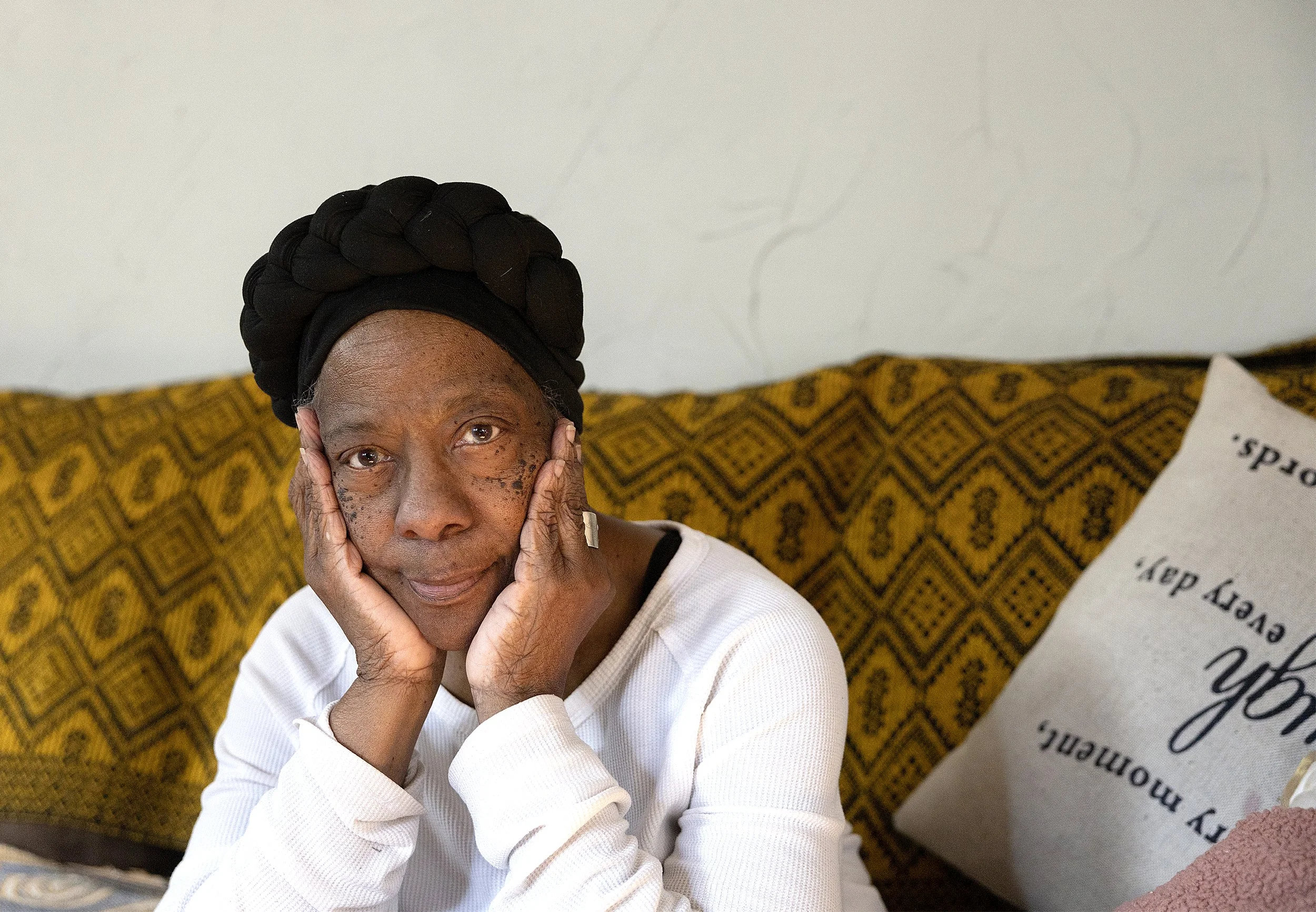
Amoke Kubat in her Northside home in 2024. Photo by David Pierini
By David Pierini, Editor
Amoke Kubat, a teacher, artist, writer and community organizer who was revered as one of the great Northside elders, passed away from cancer on Oct. 13.
Kubat was not afraid to die and wrote this summer that she believed cancer was a teacher that would help her to continue to grow as a human being.
Kubat believed responsibility awaited her once she passed away.
She wrote of her eventual transition from “Elder to Ancestor” in a 2021 essay where she reflected on death after the COVID-19 pandemic, the police murder of George Floyd, and a lifetime of social inequalities and “internalized oppressions.”
Kubat said she remained standing because of the love and protection of the ancestors. She knew then that she was on a path to becoming an ancestor.
“I do not fear death,” she wrote for Minnesota Women’s Press. “Death is not my adversary. My prayers are these: May my life have meaning and purpose until the end of life as I know it. May I greet my demise like an Olympic team member relinquishing the baton with my eyes still on the finish line. May I be a revered Ancestor. May I return born in the loving arms of my descendants.”
A memorial service is planned for Nov. 13, 10 a.m.-12:30 p.m., at Great Is Thy Faithfulness Church of God In Christ, 2901 Emerson Ave. N.
Even as her thoughts lingered on her eventual passing, Kubat continued to bring people together and engage in uncomfortable conversations, where she believed real change happened.
When Emerald Ash Borer sunk its teeth into Northside trees, Kubat spoke out against sudden tree removals and the financial burden left to homeowners. Trees were being removed and many on fixed incomes found themselves strapped with tax liens for the cost of removal.
She organized residents, community leaders, and tree scientists, and the conversation eventually forced the Minneapolis Parks and Recreation Board to find grants and donations for those unable to pay the fees.
Another leading voice holding officials’ feet to the fire on tree-removal costs was Roxxanne O’Brien, Kubat’s daughter, who has been fighting industrial pollution affecting Northside neighborhoods.
“My mom knows a lot about history, especially European history,” O’Brien said in a 2021 interview with North News. “That was one of the things she would always say, ‘If you want to understand racism, study European people.’” From her mother, O’Brien also learned to “speak what you know. Say more as you learn more.”
In 2024, Kubat reprised a play she wrote about the uneasy conversations between Black and white women. It was called “Angry Black Woman & Well-intentioned White Girl,” which explored the accusations, silences, and misunderstandings that often occur in interracial interactions.
First introduced in 2016, it played to more than 20 audiences over two years. Kubat wanted to update the play to reference George Floyd’s murder and other recent events. After each performance, the audience was invited to frank and open discussions to explore their own frustrations and discomfort.
The writing and the post-performance invitation to discuss matched the directness with which she spoke every day.
“I say things people didn’t like,” Kubat told North News in 2024. “Minnesotans have a hard time with my mouth, and it’s not like I’m crazy. It’s just I was direct. I’m used to being direct with my family. That’s how I grew up.”
Kubat was born in August of 1950 and grew up in Los Angeles, where she remembered the police brutality that sparked a six-day uprising in 1965 known as the Watts riots.
She moved from Los Angeles to Minneapolis in 1987 and received a master’s degree in special education from the University of Minnesota. She taught special education in the Minneapolis Public Schools for 25 years. She considered herself a lifelong learner and earned another master’s degree in Black church leadership at the United Theological Seminary of the Twin Cities.
In 2010, she created and hosted a workshop series on the art of mothering. The workshops became the foundation of Yo Mama’s House, a cooperative of mothers who are artists, healers and activists.
Kubat used art and writing as a way to maintain a sense of wellness even as American power systems continued to devalue and disenfranchise people of color.
“I saw injustice and inequality very early in life; I knew what it looked like and felt like even if I couldn’t put a name to it,” she said in a 2020 interview with the University of Minnesota’s Weisman Art Gallery. “My lived experience has been very formative in my work.”
In addition to O’Brien, Kubat is survived by another daughter, Keegan Xavi and three grandchildren, Jsiris Jones, Isis Bridewell and Oya Bridewell.