
ICE may exit soon, but local businesses say fear leaves lasting damage
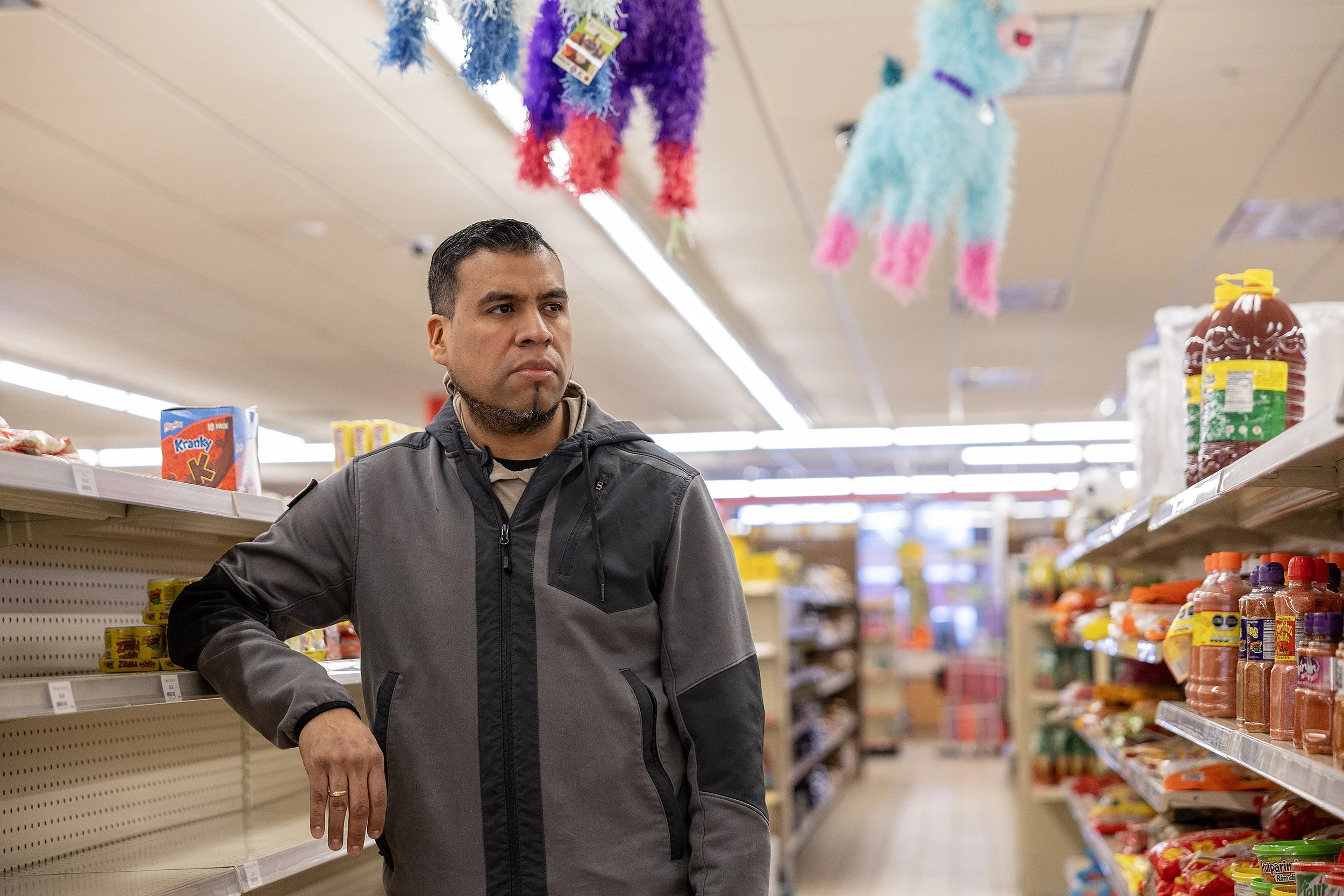
Daniel Hernandez said fear of encounters with ICE has forced workers and customers to stay away from his store, Colonial Market and Restaurant on Penn Avenue. Photo by David Pierini
By David Pierini, Editor
The day before the Trump White House announced an end to Operation Metro Surge, Northside grocery store owner Daniel Hernandez was considering selling personal assets to make payroll.
Since December, when teams of federal agents moved into Minnesota to conduct aggressive immigration enforcement, Hernandez’s Colonial Market and Restaurant lost about 90 percent of its business, he said. His workforce, once 70 strong across two stores, was down to 19.
At a store that caters to a growing Latino community, shoppers and employees alike were afraid to come to the store for fear that they could be randomly detained by ICE. Earlier that week, federal agents pulled into his store’s parking lot and approached a man in his vehicle and requested proof of legal residency. The U.S. citizen showed proof and the agents moved along.
“We are in the storm,” Hernandez said. “And then comes the aftermath. Say this ends tomorrow. People haven’t worked for three months. Once they feel safe to go back to work, they are going to put their paychecks towards rent. Many won’t be able to shop. To feed their families, they are going to find free food temporarily.
“For me, stability will come in May or June if I am still around.”
Businesses catering to immigrant communities collapsed or, like Colonial Market, suffered heavy losses as bands of roving federal agents struck fear in the hearts of Twin Cities residents.
In just the month of January, financial losses to Minneapolis businesses and workers reached an estimated $81 million, according to the city’s office of Emergency Management. The report on the economic impact of Operation Metro Surge also left more than 76,000 residents, about 20 percent of the city’s population, in need of some sort of food assistance.
The report on the economic impact, totaling more than $203 million, is likely an undercount, said Emergency Management Director Rachel Sayer.
“The impacts we are seeing as a city will be felt for decades, even generations to come,” Sayer said at a news conference Friday. We need significant funding assistance to meet the urgent needs of our community. This surge has been devastating to so many of our friends and neighbors. It is our collective duty to take care of them.”
In the same news conference, Mayor Jacob Frey demanded some form of federal restitution, but that is unlikely to come soon, if at all.
City officials and state lawmakers are trying to raise money to help shattered businesses recoup some of their losses. Those same leaders must also figure out how to help stave off an emerging eviction crisis, which also could easily require millions of dollars statewide.
“I’ve tried to be thoughtful around all of the small businesses around the state, because we know the occupation of ICE has had a detrimental impact on all of our small businesses,” said Senate President Bobby Joe Champion, chair of the Jobs and Economic Development Committee, on the eve of the current session. “I’m trying to figure out if there is a mechanism or if there’s even going to be money (to help small businesses).”
Gov. Tim Walz is proposing $10 million in relief funds for small businesses hurt by the ICE surge. The forgivable loans would range from $2,500 to $25,000. The 2026 legislative session began on Feb. 17.
Similarly, the Minneapolis City Council approved a $7 million fund to help small businesses that awaits Frey’s signature.
‘The damage is done’
North Minneapolis-based Tri Construction employs most of its own tradespeople, rather than subcontracting for certain specialties.
Of the 40 or so workers who do carpentry, framing, and hang drywall for Tri Construction, about 60 percent are Latino, and they are afraid to leave their homes for work, said co-owner Calvin Littlejohn.
Even with news of a drawdown, Littlejohn said he wonders when people will feel safe enough to return to work.
“Here’s the tough part,” he said. “The ice enforcement is really just targeting people of color, and they’re going to the places where they know people of color live, work, and play. And so, this narrative about, ‘we’re trying to get the worst or the worst,’… No, they’re not. I haven’t seen them pull over a white person to see if they’re from Canada or Europe who overstayed their visa. It’s an enforcement of non-whites.
“The damage is done. I don’t know how you bounce back.”
Ahmed Omara, who owns Olympic Café on West Broadway Avenue, has had to give rides to two of his employees so that they could feel safe traveling to and from work. “It’s too hard to find good workers,” he said regarding his decision to give rides to some of his employees. “I carry my passport with me. I never do that.”
A third employee, a light-skinned Black woman, said she had her plates run by federal agents who pulled in behind her in a shopping center parking lot.
Omara said customers coming into his restaurant have also dwindled.
“I’ve lost about 50 percent of my usual business,” he said. “Even people who are legal citizens are afraid to come. They tell me they killed a white lady and a white boy.”