
Northsider felt secure with DACA status. Then he was detained
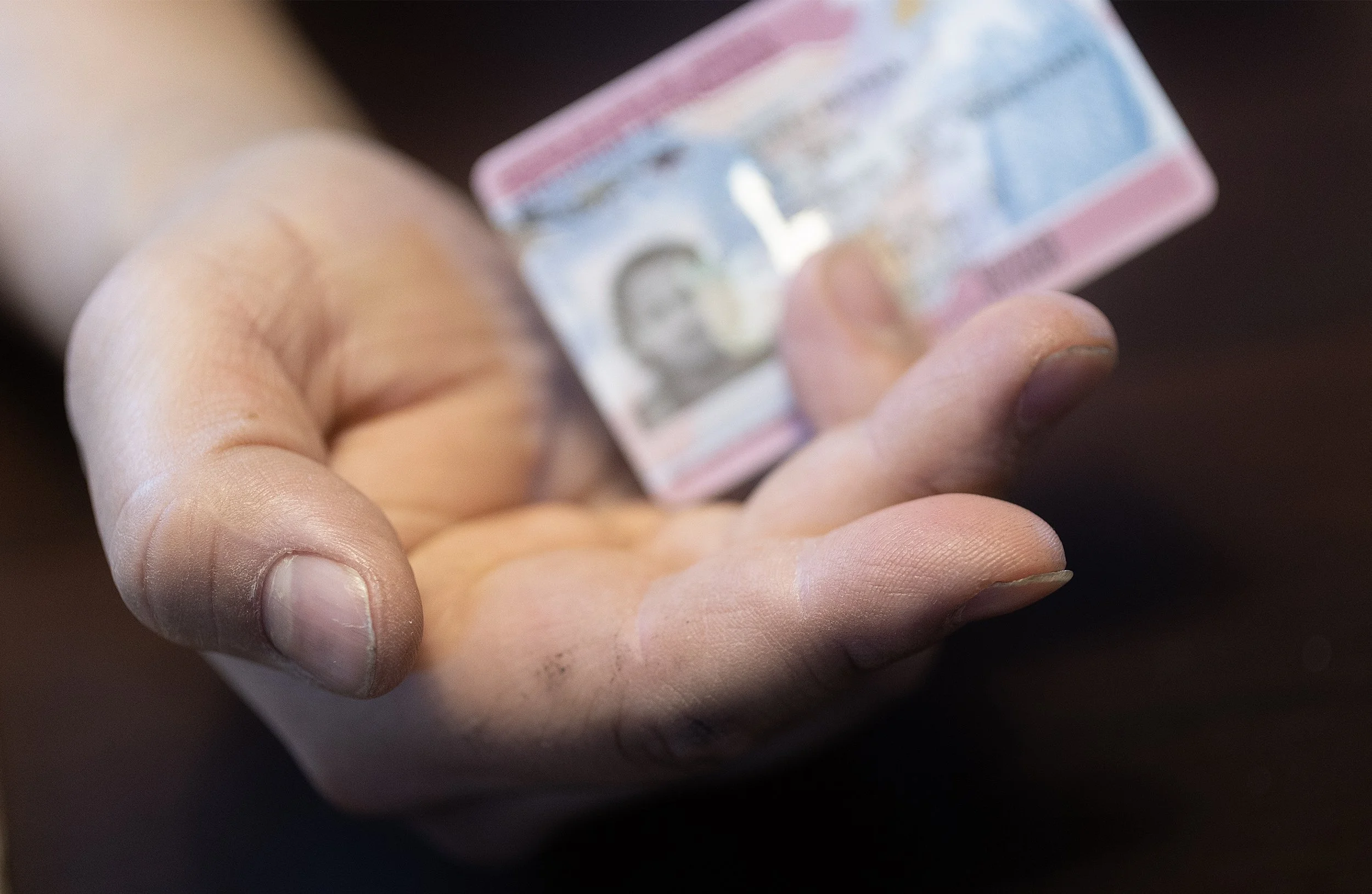
Walter’s DACA card and clean record did not protect him from being detained. Photo by David Pierini
By David Pierini, Editor
Walter wasn’t too concerned when federal agents blocked his car from leaving his bank’s parking lot.
The 38-year-old Northsider, a native of El Salvador, had a valid DACA card and a clean record. DACA, short for Deferred Action for Childhood Arrivals, gave him legal status to live and work in the United States.
But that didn’t matter to the ICE and Homeland Security agents who took him into custody and told him, “You’re not legal here.” Even after he arrived at the detention site, another officer seemed puzzled about why Walter was detained. He told him to follow the process and that he’d likely be released in a few hours.
It took him nearly three weeks to get home.
After sleeping on a cold floor in a crowded holding cell at the Whipple Federal Building in Saint Paul, his hands were zip-tied as he boarded a deportation flight that landed in El Paso, Texas. There, he was booked into an overcrowded detention center rampant with COVID-19. One detainee died while Walter was in El Paso, he said.
At 14, he had crossed a rain-swollen, swift-moving Rio Grande River. He used a flotation ring because he didn’t know how to swim. When he got to land, he soon discovered he was on a private ranch with signs that warned trespassers could be shot.
But Walter’s detention at the Whipple Building in Saint Paul and later in El Paso scared him more.
“This was the most painful thing I had to endure in my life,” said Walter, who was eventually released. “It was like being kidnapped and put in jail for no reason. I was scared.”
North News interviewed Walter and his fiancée, Symone, and agreed not to use their last names because they fear retribution. Even as news broke in early February of Homeland Security pulling scores of agents out of Minnesota to end Operation Metro Surge, Walter remains skeptical.
“This is a tactic for people to lower their guard so that they can catch you,” he said.
“We heard of agents telling DACA recipients that their DACA was no longer real protection. Then, more and more DACA recipients started to get picked up in targeted operations at their homes, their workplaces, and in their communities. ”
Dream interrupted
DACA is supposed to shield immigrants who arrived here as children from deportation. President Donald Trump had lost a Supreme Court case in his first term to eliminate the program, first enacted by President Barack Obama in 2012.
Despite the ruling, the Trump administration has encouraged recipients to self-deport. Rather than a second attempt at eliminating the program, officials are changing the rules.
“DACA does not confer any form of legal status in this country,” Department of Homeland Security assistant secretary Tricia McLaughlin said in a statement earlier this year. "Any illegal alien who is a DACA recipient may be subject to arrest and deportation."
A coalition of immigrant rights groups last year developed a tracking system for detentions and deportations. But the federal government does not provide information on DACA recipients swept up by the immigration crackdown.
Some lawmakers and watch groups say ICE raids are grabbing people at random more so than from targeted enforcement of known criminals, as initially declared in the early days of the surge.
United We Dream tracks card-carrying recipients detained and deported through media reports. The youth-led immigration rights group has recorded around 30, but fears the number is much higher.
There were more than 530,000 DACA recipients as of last fall, according to U.S. Citizenship and Immigration Services.
“We started tracking because there's been an alarming pattern of immigration agents targeting people with DACA,” said Juliana Macedo do Nascimento, spokesperson for United We Dream. “We heard of agents telling DACA recipients that their DACA was no longer real protection. Then, more and more DACA recipients started to get picked up in targeted operations at their homes, their workplaces, and in their communities."
‘We couldn’t find him’
Walter was given a chance to call his finance when he arrived at the Whipple Building. After they briefly talked, an agent joined the call with Symone to say the keys to his car, left in the bank parking lot, were under the mat. She said the agent then told her to come to the Whipple Building to pick up Walter after she retrieved his car.
Once there, she was told he couldn’t be released because it was the weekend. She was given a phone number to reach him. It turned out to be a tip line, she said.
“We couldn’t find him on the detainee locator (web page) at first, but when he finally showed up, he was already in Texas,” Symone said. “I was calm the first day, but by then I was a crying mess. That’s when his mother said, ‘Ok, we have to think about what to do.’ So, I just started doing research.”
Within a couple of days, they found an attorney, but getting to Walter was not easy.
The detention facility was privately run, and guards there seemed to have little regard for due process or the conditions in which detainees were living, Walter said. For a bad back, Walter requested Tylenol and never received any.
But when he saw a man with a high fever and difficulty breathing, he tried getting guards to get him medical help that never came.
He finally met with a federal official who, like one of the agents at Whipple, was confused as to why he was detained.
It took another 72 hours, but without much explanation, he was released on Jan. 22 and driven to a shelter run by Annunciation House. There, he was safe but could not get home because the detention center did not return his DACA card or driver’s license.
Annunciation House Executive Director Ruben Garcia said his shelters have an arrangement with Border Patrol to take in people being released from detention. Immigration status varies, but little makes sense to him about why people are detained in the first place.
“It has been catastrophic,” Garcia said. “I have a hard time communicating to people what it is like. You get up, you get ready for work, you drive away, and then you get pulled over, and none of the documents that you absolutely take for granted mean anything.
“It goes to the core of the trauma people experience. You trust the information that is given to you, which you are supposed to rely on. They don’t let you call your lawyer or contact your family, and then you find yourself far away.”
Symone drove to Texas to bring Walter his paperwork so that he could leave El Paso and return home.
He arrived back in North Minneapolis on Jan. 25, the day of his youngest son’s birthday. He also returned to his job as a delivery driver.
Walter worked to help Symone finish college, and she plans to do the same for him. But first, they want to finally get married, because they love each other and have been together for 11 years.
But they also hope being married will add a layer of protection.
Less than a month after his return, Walter was picking up food from a Mexican restaurant. As he pulled away, a dark SUV without a front plate began to follow him.
He was sure it was an ICE vehicle and that agents inside were running his plate. After 10 minutes, the vehicle turned off the route.
“Maybe they saw I was DACA and they left me alone,” Walter said. “For me, it’s scary. They know who I am. I just want to be left alone. That’s the only thing I want.”