
He was indicted for answering call to ‘raise awareness’
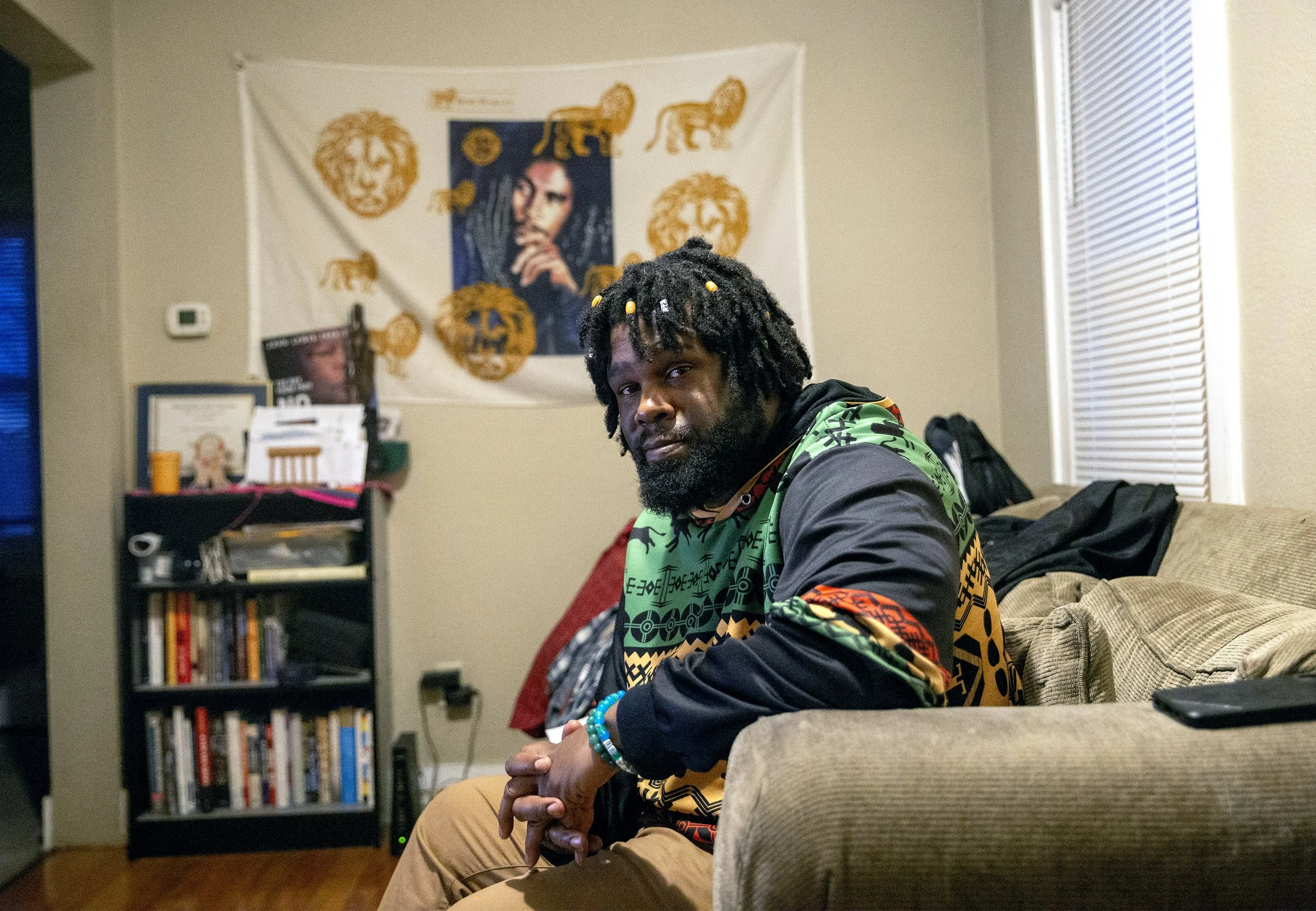
Drew Edwards sits on his living room couch a week after his arrest. Photo By Azhae’la Hanson
By Azhae’la Hanson, Reporter
The alarm clock went off at 6 a.m. for Andrew Edwards to begin his day with meditation.
Soon after that, he heard rustling outside.
“It sounded like people were on the side of the house, and the back of the house,” he said of that morning on Feb. 27. “That's when I opened up the blinds, and they pulled up their guns. They clicked on a light and said, ‘Put your hands up.’ They said go to the front door.”
By the time he got to his front door, federal agents broke it down and pulled him outside. He was in his underwear and not allowed to put on pants.
They told him they had a warrant for his arrest.
“They took off my headwraps,” he said. “All I had on was a shirt and just my drawers.”
When asked why he was arrested, the agents said, “They’ll tell you when you get there.”
He was then taken to the Bishop Henry Whipple Federal Building and held for a court hearing. Edwards is one of 39 people who received a federal indictment following a protest at a Saint Paul church in January.
During an arraignment hearing on March 19, Edwards pleaded not guilty to charges relating to the Jan. 18 protest at Cities Church, which has gained national headlines. Two prominent journalists covering the protest were also indicted.
Edwards, who lives in North Minneapolis, answered a call to join the group at the church, where an ICE field office director was a pastor. That pastor, David Easterwood, was not present during the protest.
Edwards didn’t know he might get arrested. Had organizers raised this, he said he still would have gone.
His attitude is not unlike that of most Minnesotans during Operation Metro Surge. A dedicated community has developed in the state to protect each other, no matter the consequences, as the operation has depleted resources and left unprecedented crises in its wake.
Those actions have taken various forms of mutual aid, rapid response networks, protesting, and policy advocacy.
Edwards was charged with conspiracy against religious freedom and interfering with the right of religious freedom through means of intimidation or injury–the federal civil rights law known as the Freedom Access to Clinic Entrances (FACE Act), which includes freedom at a place of religious worship.
The federal government has also cited the Ku Klux Klan Act of 1871, which was written into law to protect Black people from the KKK in places of worship.
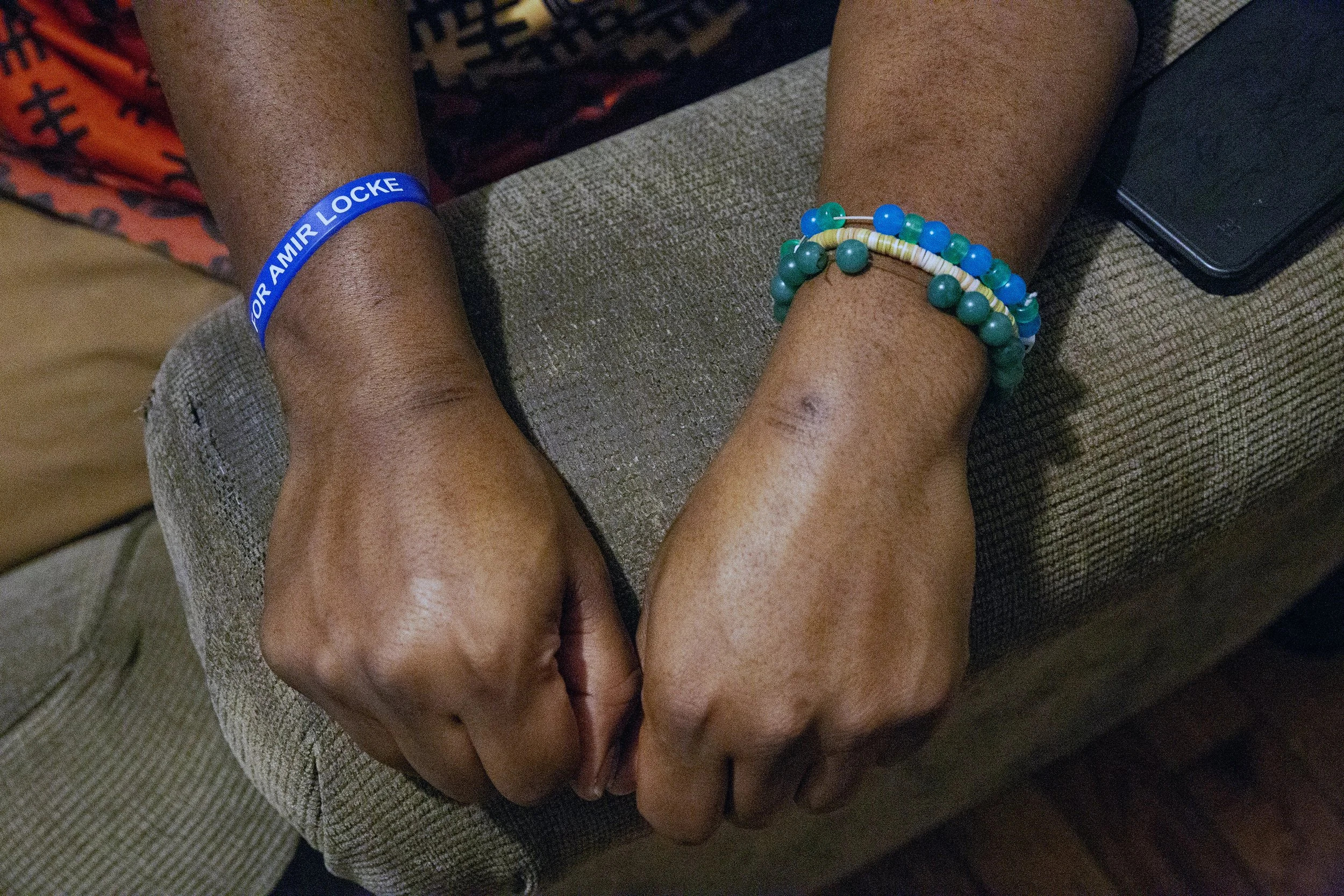
Edwards wrists were still bruised two weeks after his arrest. Photo by Azhae’la Hanon
Since the protest, the group has been arrested and indicted in waves. Edwards was among the last to be arrested.
Claim of conspiracy
Prosecutors filed conspiracy charges based on a social media flier for “Operation Pull Up” that was posted the night before the protest.
The flier told “fellow agitators” where to meet “to prepare for the operation, exhorting them to be ready to mobilize,” according to the complaint.
Edwards shared the flier on his personal social media account.
“That is their piece of evidence,” Edwards told North News. “Sharing it. Me not even having a conversation with the person or knowing anything about the event. Sharing the event is not me conspiring.”
Edwards said he wasn’t even aware of what “Operation Pull Up” was until he met the group at a St. Paul Cub Foods on Jan. 18.
The conspiracy charge includes gathering at Cub Foods prior to going to the church. That was when Edwards learned a church pastor worked for ICE.
The indictment alleges that protestors caused terror for congregants and staff at Cities Church.
The protest is referred to in the complaint as a “coordinated takeover-style attack” that engaged in acts of “oppression, intimidation, threats, interference, and physical obstruction.”
Prosecutors claim that “congregants fled the church building out of fear for their safety. Others took steps to implement an emergency plan, and young children were left to wonder, as one child put it, if their parents were going to die.”
Edwards described the protest as more of a heated dialogue rather than a dangerous situation.
He said the group sat in the pews through worship and announcements. Afterwards, he recalled civil rights attorney Nekima Levy Armstrong asking the pastor if he knew about Easterwood’s involvement with ICE.
She was met with the pastor yelling “shame” back at her.
From there, Edwards said some congregants got up and left, some prayed, and some stayed and engaged with protestors.
“Me and a brother agreed to disagree,” Edwards said. “I told him, ‘Well, hey, we came here to hold people accountable for the things that are going on.’”
Edwards and Levy Armstrong deny the claims that protestors threatened the church's congregation and physically obstructed people as they attempted to exit.
Prosecution said that protestors led and joined together in various chants, such as “ICE out!” and “Justice for Renee Good.” From the chants and alleged hostile, aggressive gestures, the staff perceived them as threats of violence and a potential prelude to a mass shooting.
“They are elevating discomfort amongst those in the church to criminal activity when it wasn't,” Levy Armstrong told North News. “It was a nonviolent, peaceful demonstration. Of course, it may have made some people uncomfortable, but did any crimes happen? Absolutely not.”
The prosecutor alleged that a protester raising their arm in a fist was “punching the air,” and thus alleged physical obstruction and intimidation of the congregants.
People raising their fists during protests are common, dating back to the 1910s. The Black Power fist is a well-known symbol dating back to the Civil Rights movement.
Edwards said the complaint uses inflammatory language to exaggerate a narrative that favors President Trump’s administration and punishes people who speak up against it.
“I believe this (narrative) comes directly from the administration,” Edwards said. “We walked out of the church, and we walked away, and everybody went home safely, including us.”
There were bruises on his wrists visible two weeks after his arrest. They shared a space with bracelets that read Justice for Amir Locke and green chakra beads. Green represents the heart chakra of self-love and love for others.
Edwards said he wouldn't put the term “activist” in his vocabulary to describe himself. He says he’s just a person doing what’s required of him.
“Me personally, if somebody says, ‘Drew, you need to cook.’ Yes, if that's required,” he said. “If the solution is as easy as cooking, I would cook. If it was something else, I would do that.”
Edwards said his parents raised him to be a part of the community he comes from and to be the change he wants to see. He has served as a football and writing coach, and an English teacher across the Twin Cities. He also owns a clothing brand called ‘Know Your Worth.’
When he went before the judge on Feb. 27, he did so in his underwear. Edwards said it was a deliberate choice to remind those watching.
“They didn't take the decency to give me a moment to grab my pants,” he said. “You're not going to dehumanize me; you don't get my dignity. I wanted the judge to see what they did.”
It wasn’t the only way Edwards wanted to leave an impression that day. He told Department of Homeland Security agents who crossed his path at the Whipple Building to use their skills and talents and put their energy to good use.
Edwards said it was something he would likely say to his students.
“There is so much innovation based on fear and what you fear somebody will do,” he said. “How about you create and do it out of love and make something happen for people, instead of doing it out of fear and trying to create consequences and doing it with impunity.”
The prosecution requested more time to disclose additional evidence.
“These are bogus charges,” Levy Armstrong said outside of the courthouse. “They keep asking for extensions because they don’t have their act together.”