
Are we there yet? Teachers and students struggle with senioritis
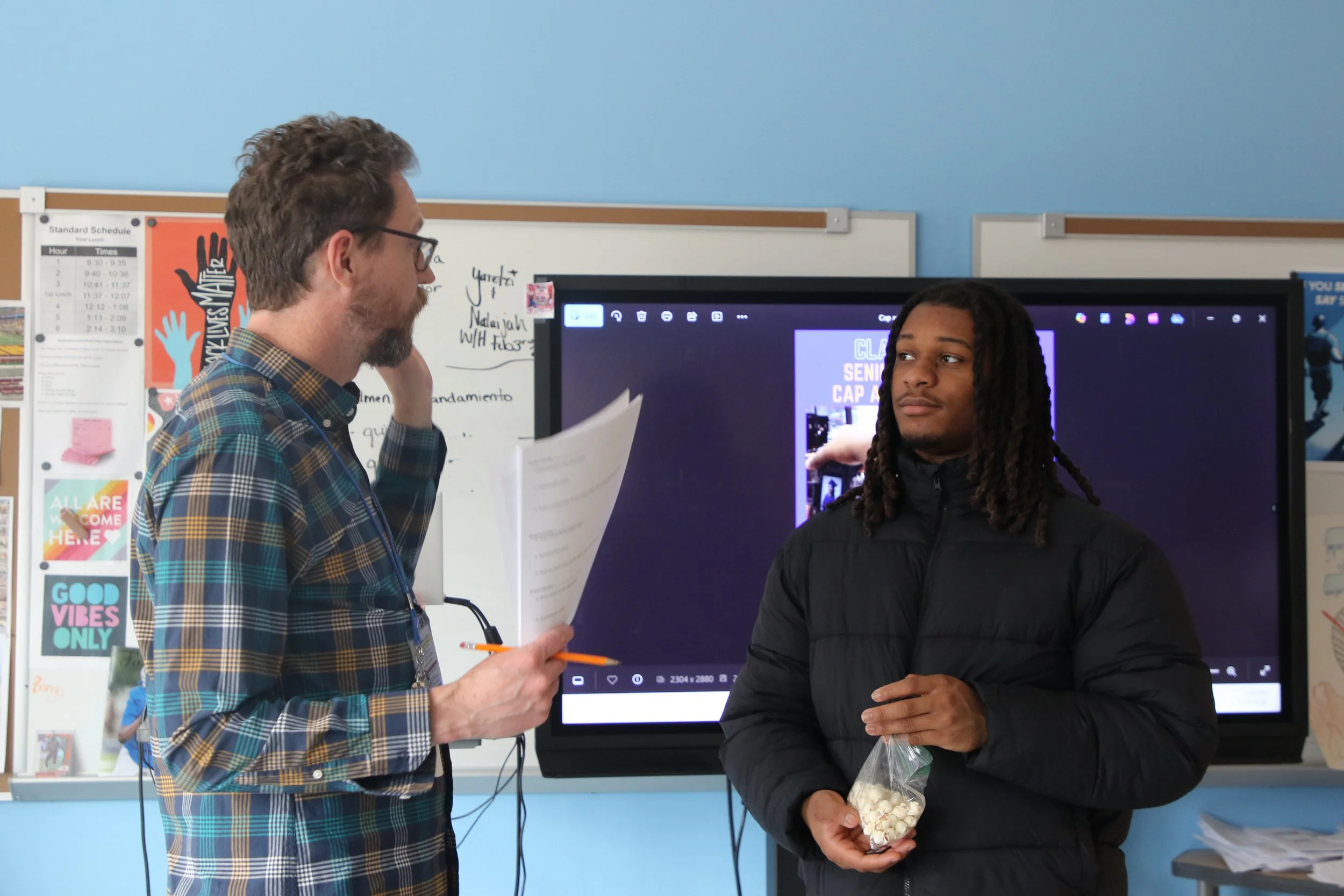
High school senior, Anerse Dotson, right, consults with his social studies teacher Samuel Wilbur about an assignment for journalism class. Photo by Kiya Darden
By Kiya Darden, North News intern
Every year, countless high school seniors experience the ultimate academic burnout that threatens not only their grades but also their post-secondary future and even their extracurricular activities.
The effects of this burnout, otherwise known as senioritis, are well acknowledged. Still, every year, teachers and students debate the true cause of such a detrimental loss of energy.
Some teachers and school staff interpret senioritis as a state of comfort that arises when students become set in their routines, whereas some students feel more afraid of the future than nostalgic for the past. Either way, the impact of senioritis on academic performance is very real.
But where is the line between simple laziness and underlying mental health concerns? Who notices when that line has been crossed, if it affects students all the same?
“It just makes me, like, completely lazy, like it makes me tap into the free will I feel like I didn't have before,” North High senior Anerse Dotson said. “I was just so stressed about work, like getting all my assignments turned in.”
Leading standardized test and college prep websites for high school juniors and seniors attribute senioritis to a lack of motivation.
The ACT website defines “senioritis” as a term for the drop in motivation often experienced by high school seniors as they approach graduation.
On the College Board website, tips on preventing senioritis suggest things like “maintaining a challenging course load” and “challenge yourself.”
North High senior Kymani McLane-Taylor, however, says the language on these sites paints an unfair narrative that blames students.
“I feel like they try to downsize us,” McLane-Taylor said. “They're like, ‘It's not even that serious, you haven't seen anything, you're just getting started.’ ”
Patience Dolo, a counselor at also identified a gap in the understanding of what causes senioritis. She said things like mental health have a bigger role to play.
“I think people who are really struggling are not calling it senioritis,” Dolo said. “In that sense, from the outside looking in, it might look like senioritis, but it might be something more than that.”
According to Dolo, some features of senioritis, like the loss of motivation, anger and irritability, emptiness, lack of energy, and interest in hobbies, also strongly correlate with common signs of depression.
Dolo’s recommendation is asking for help.
“Communication is really important. I always tell students, even if you are going through something, just tell somebody,” Dolo said. “Tell somebody so that at least somebody knows what's going on with you, and they're also more likely to help you figure it out.”
Dotson said working harder in school means a tougher crash near the finish line. In his case, Dotson burned out after an intense four years of academic prowess.
“It's my last year, and I'm still grinding my butt off, and I just want to chill,” Dotson said. “I haven't been able to chill all four years of high school. I want to chill now.”
Peter Branstad, a 12th-grade AP microeconomics teacher, said he struggles with teaching seniors and has seen senioritis in all of his classes. He agrees that the one big difference between the seniors in his advanced classes versus the standard ones are the much higher expectations put on the former.
“The only difference is that in advanced classes, there are greater expectations on these students,” Branstad. said. “These classes are where the senioritis is most frustrating because I am expected to prepare these students at a college level, but they often get hit with the senioritis, and it is harder to teach them effectively.”
Branstad tries to combat senioritis in the classroom by incorporating fun activities and games.
“I feel that with education in general, we should find ways to incentivize genuine learning and not just work completion,” he said.
Kymani feels a paralyzing dread that intensifies with each day closer to graduation.
“It's like when you start to realize that life was going by too fast, by the time you're a senior, you're like, I don't have any more time to do what I wanted to do.
She talks to her friends about her panic, who call her a broken record.
“I am an overthinker. I also start to get a little sad, like, do you guys not feel the shift? I don't know. It's just coming. It’s like I'm warning people about the Rapture.”
While sometimes she fears the future, she says senioritis is only temporary.
“Life in a year, it's gonna be so much more colorful,” McLane-Taylor said. “I'm gonna be meeting so many new people, new places, and I'm not even gonna think about this. So I just gotta continue to keep it on my mind. So I think everybody should do the same.”