
City funds relocation for Heritage Park residents
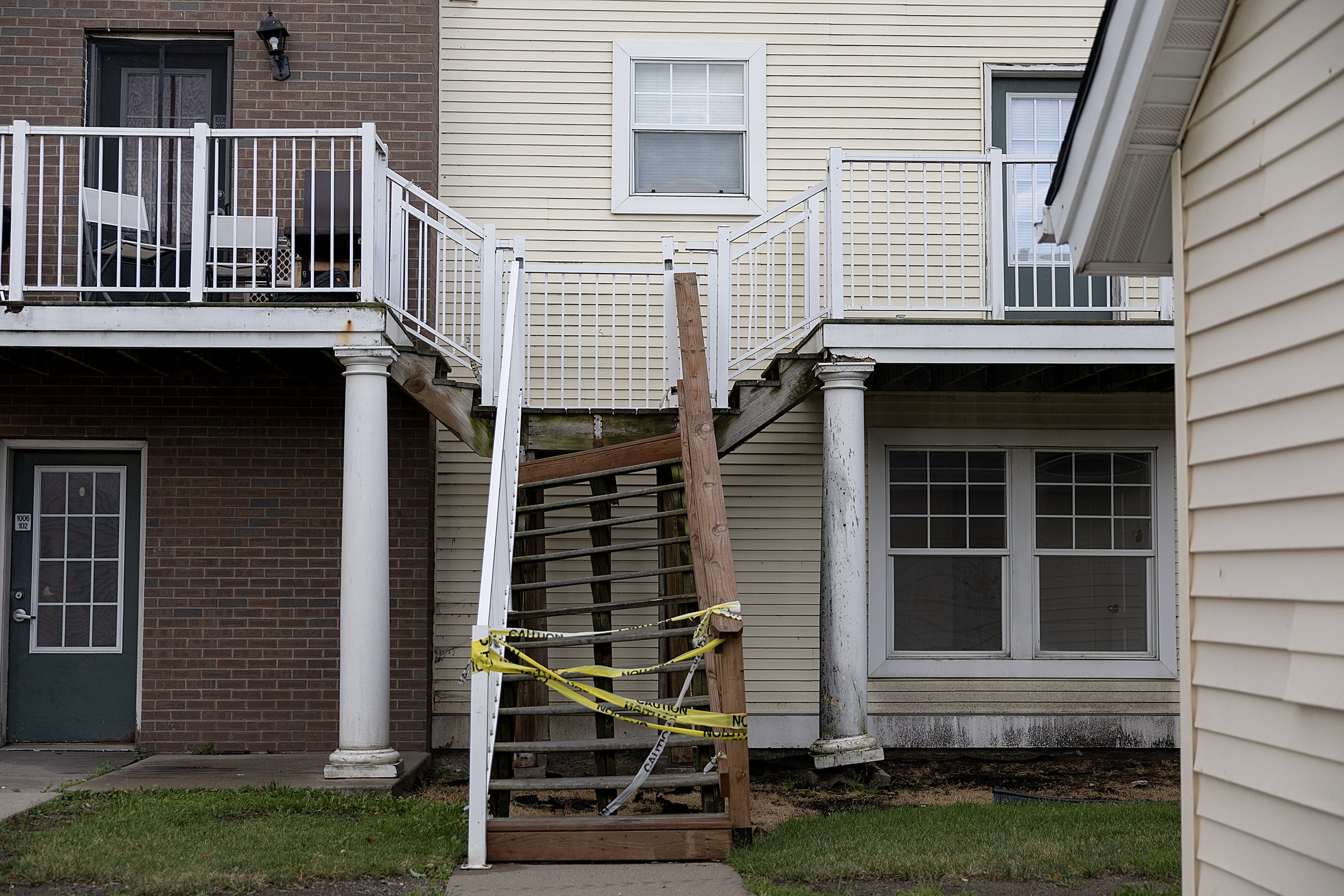
Boarded up windows, broken window blinds and caution tape are just a few of the signs of decline at the Heritage Park townhomes. Photo by David Pierini
By Melody Hoffmann and David Pierini, North News staff
The City of Minneapolis has put aside $2.5 million to potentially relocate nearly 700 residents of a community of Northside townhomes once considered the shining future of public housing in the early 2000s.
Over two decades later, the residents of Heritage Park live in dilapidated units infested with rats and ravaged by mold. About half the units are vacant and uninhabitable for new tenants to move in. Mold damage is more severe on the lower floors.
The Minneapolis City Council voted unanimously on July 16 to use money from its Affordable Housing Trust Fund to get residents into safe homes while Heritage Park undergoes repairs. The money can also be used to rehab the buildings.
“Rehabilitation needs that may be funded include roof repair, insulation, furnace installation, and other related health and safety rehabilitation costs,” the contract the council unanimously agreed on reads. “Alternatively, some or all of the funds may be used to finance relocation expenses as required by rehabilitation/ repair activities.”
Relocation funds will be requested if residents are ineligible through the Minneapolis Public Housing Authority or the U.S. Department of Housing and Urban Development.
The directive also requires City staff to provide the council with regular updates on the progress of helping residents relocate amidst repairs. A report given to the City Council on July 14 cited “a complex set of processes and approvals” in moving forward with repairs.
Council members admonished city inspectors, the Minnesota Public Housing Authority and the property owners for allowing the units to go uninspected for several years.
“There is no amount of money that can really help the residents who are struggling here,” Ward 6 Council Member Jamal Osman said. “The City department that oversees licensing has to do better. Having let this go on, we end up figuring out how to help this group, and it’s costing us $2.5 million. There are more apartments like this in the city. There has to be a better process.”
According to the City’s Regulatory Services, the City began property-wide inspections at Heritage Park when “conditions became more concerning” in October 2025.
The City found 974 violations between October 2025 and January 2026, and there are still 863 violations as of July 2026.
“We are evaluating a threshold question of are the repairs needed exceed the cost of just rebuilding the building,” Community Planning and Economic Planning Director Eric Hansen said at a council meeting on July 14. “At this moment in time, we can’t answer that question.”
Ward 5 Council member Pearll Warren has amplified the plight of Heritage Park residents and pressed the City to intervene since taking office in January.
Warren posted a video on her Ward 5 Facebook page on June 15 that combined a visual collage of apartments damaged by mold as Warren reads a poem.
“We know what it feels like to be promised investment, and handed abandonment. To be promised opportunity and handed delay. To be promised transformation and handed deterioration,” Warren reads in the video as images cycle through of apartment walls speckled with black mold and rooms abandoned with trash.
After Warren’s video gained a wide audience in June, tenants opened their doors to the news media and confirmed what Warren showed in her video.
The Minneapolis NAACP called for the resignation of the Minneapolis Public Housing Authority Executive Director Abdi Warsame in late June. MPHA responded by stating it is not responsible for maintenance at individual apartment sites.
“MPHA’s primary responsibility in the project was to send McCormack Baron Salazar HUD-calculated operating funding for 200 units designated public housing that the owner, McCormack Baron Salazar, operated,” a statement MPHA issued in late June reads.
McCormack Baron Salazar started developing Heritage Park in 1999 with 900 homes, 440 rental units, and 360 available to purchase. All Heritage Park housing is mixed-income, including affordable housing, workforce housing, and market-rate housing. McCormack Baron Salazar signed the property over to a receivership in December 2025 after not paying its mortgage.
The original intent of Heritage Park was to lessen the concentration of poverty in Near North Minneapolis after a lawsuit targeted the concentration of public housing in the same area.