
North News interns ask the tough questions about youth gun violence
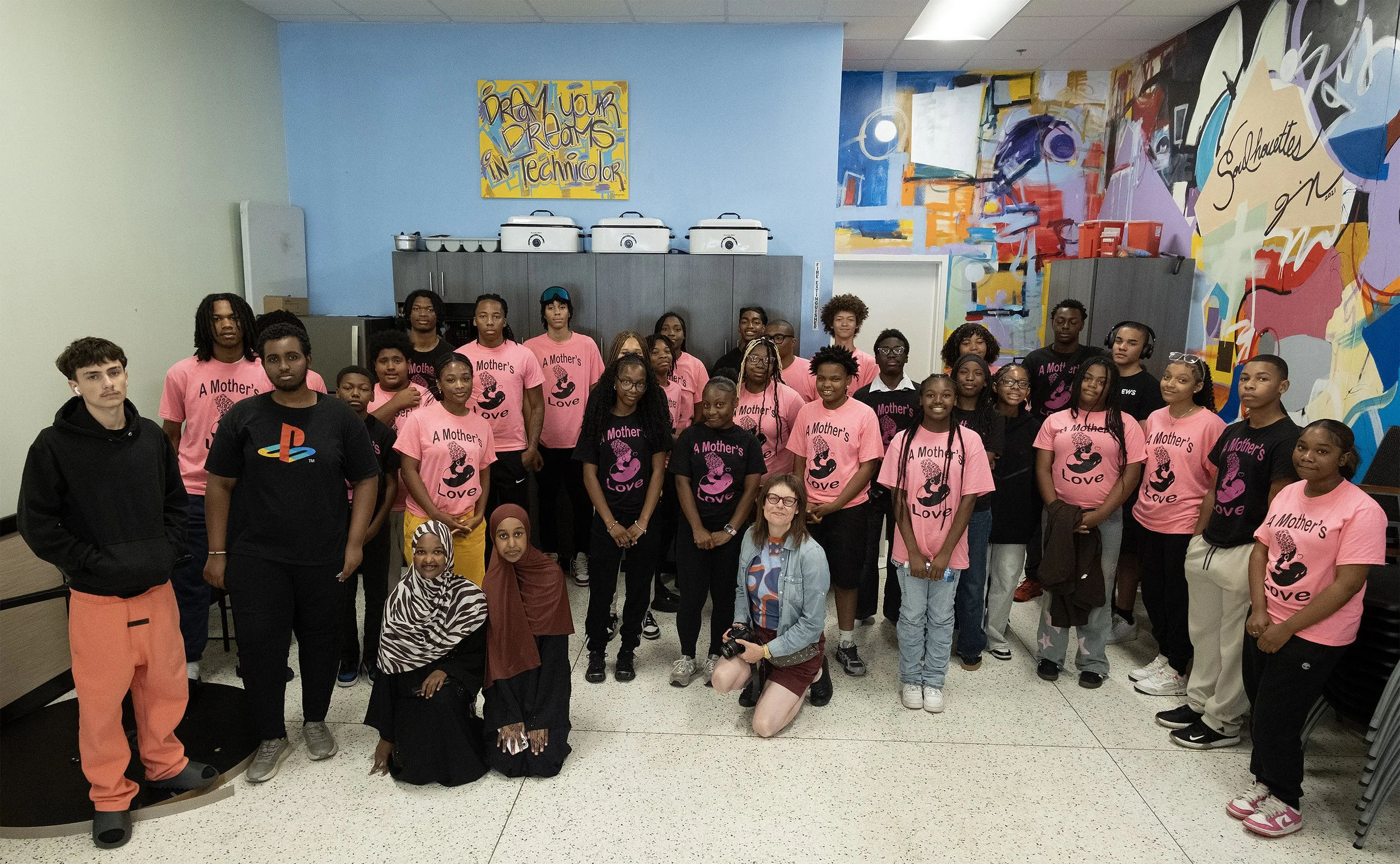
North News StepUp interns gathered with youth form A Mother’s Love for a group photos after a wide-ranging discussion about youth gun violence.
By Melody Hoffmann, Reporter and Youth Program Leader
For the August edition of North News, we asked our interns to spend their summer reporting on how gun violence affects North Minneapolis.
Over a couple of intern classes, we learned that our youth have a unique perspective and ask tough but fair questions.
Last summer, an 11-year-old boy, Amir Atkins, was shot and killed by a teenager at Folwell Park, and our interns attended a community-led press conference where they heard Princess Titus speak about losing her son to gun violence.
This past school year, an intern reported on why teenagers are so desensitized to gun violence.
We knew we needed to write more about this topic.
We continued our reporting this summer by reconnecting interns with community members we have interacted with over the past year. One of our interns spoke with Princess Titus at length for a story about how mothers handle the unthinkable tragedy of losing their child to gun violence.

Mike Tate met with interns Saadiya Saed, left, and Hanan Abdullahi for an interview on how youth programs can help kids make good choices. Photo by Azhae’la Hanson
Gun violence saw a sharp decline nationwide in 2025 to rates we haven’t seen since 2015, according to The Trace, but homicides are still impacting cities disproportionately. Black boys are still more likely to die from gun violence than any other cause.
Of the homicides statewide in 2025, 41% of the victims were Black, 29% were white. According to U.S. Census data, African Americans make up only 8.3% of Minnesota’s population; white people make up 79.8%.
Homicides are still common in North Minneapolis, but the stereotype that they only happen here does not bear true.
From data recorded from the Minneapolis Crime Dashboard, Precinct 4 in North Minneapolis recorded 16 homicide deaths from September 2025 to July 2026. Precinct 3 in South Minneapolis recorded 18 homicides. Precinct 5 in Southwest Minneapolis recorded 15 homicides; Precinct 1 in downtown Minneapolis recorded nine homicides. Precinct 2 in Northeast had the lowest number of homicides with four.
North News is known for moving beyond stereotypical, superficial coverage of the Northside. This summer we wanted to dedicate our internship program to digging deeper into the why and how of gun violence.
Our interns each chose a topic of their interest and interviewed community members and law enforcement to get answers to questions about why cases go unsolved, how young people get guns, and how to get people to stop picking up a gun. Patterns began to emerge in what they found.
Lt. Kelly O’Rourke with the Minneapolis Police Department told intern Dominic Cintorino that the majority of gun violence in Minneapolis involves illegally purchased guns. MPD can quickly look up a gun’s status through the National Crime Information Center Gun File in their squad cars.
Interns saw their reporting reflected at the government level. Minnesota Attorney General Keith Ellison sued Fleet Farm in 2022 for ignoring red flags and selling firearms to straw buyers (who sell guns to people illegally).
The gun that killed 6-year-old Aniya Allen and Trinity Ottoson-Smith, cases covered in this issue, was also bought at Fleet Farm by a straw buyer. That buyer was not part of Ellison’s lawsuit.
There are powerful stories embedded in the work our interns did, some of them just entering high school with intimate experiences with gun violence themselves.
As we sat with the interns for the interviews, answers about what youth need to stay out of trouble emerged, but a sense of helplessness also filled the room. We had the answers, but would anyone listen?
We hope the people with the time, power, and resources to make a difference are here with us, reading this special edition.
Guns pass through many hands in Minneapolis
By Jaedin Rooney, North News Intern
Minneapolis law enforcement and community members say firearms remain readily available to teenagers in North Minneapolis, contributing to gun violence and making it difficult to reduce gun-related crimes.
“Guns are valuable,” Minneapolis Police Department Lt. Kelly O'Rourke told North News. “Guns bring status on the street.”
O'Rourke said investigators frequently recover firearms that are linked to several different crimes.
“It’s very common to find that the same gun is used in multiple different crimes,” O’Rourke said. Reporters Milania Little and Shy Martin report on this very issue on page 13.
While MPD confiscates hundreds of guns each year, O’Rourke says there are “equally as many guns still out there.”
He described the issue as “a proliferation of guns in our neighborhoods.”
O’Rourke said the City of Minneapolis has not held a gun buy-back program during his 12 years with the department.
Instead, O’Rourke says that reducing youth access to firearms will require preventing illegal gun trafficking, securing firearms to prevent theft, and continued cooperation between police and community organizations.
While law enforcement focuses on removing illegal firearms from the streets, community members say preventing youth from accessing guns must begin at home.
In a group conversation with youth interns at A Mother’s Love, they said buying guns is as easy as going online or getting one from their elders.
“I think it's going to take more than just a couple billboards to stop,” one intern said.
The perspective often missed in news coverage
By Muhamad Ali, North News Intern
A police press report lands in a reporter’s inbox with details of a neighborhood shooting. The document is quickly condensed into a brief report. While technically complete, one element is entirely absent: the voices of the people who live where the shots rang out.
North News conducted an informal analysis of written crime coverage in North Minneapolis versus coverage in neighboring suburbs of Brooklyn Park and Edina from TV news outlets, FOX 9, WCCO, KARE 11, and KSTP.
Each outlet produced similar short articles (80-250 words), relied heavily on police reports, and rarely included quotes from residents or people in the area.
Three articles outside North Minneapolis included community voices, but the same number of stories outside the city also lacked them, showing similar issues beyond the city.
Kenzie O’Keefe, former editor of North News, said dwindling financial resources and workforce capacity in newsrooms may be the reason for short crime stories.
“It's easier to use the police report or the press release in your email inbox than it is to go pound the pavement and have really difficult conversations with community members,” said O’Keefe, the executive director of ThreeSixty Journalism at the University of St. Thomas.
The vast majority of articles also were not accompanied by a follow-up story.
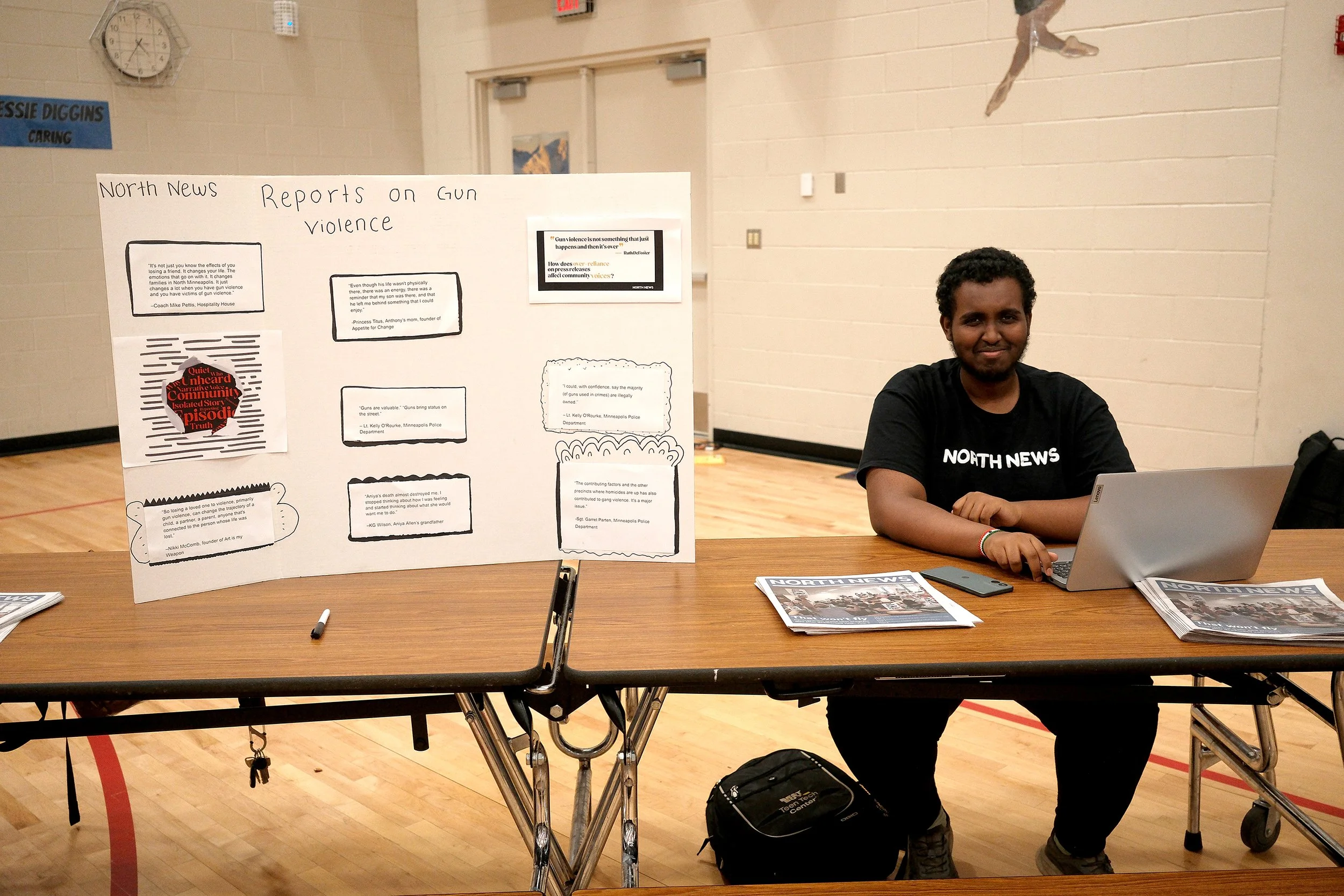
Intern Muhamad Ali tabled at a summer showcase to discuss the youth gun violence project with visitors. The showcase hosted by Pillsbury United Communities, which operates North News, to highlight the agency’s youth programs. Photo by Azhae’la Hanson
KARE 11 News Director Matt Kummer said the lack of follow-up coverage ultimately rests on the community’s willingness to share their stories.
“Sometimes they don't want to say anything at all, and then that hampers us a little bit,” Kummer said.
By relying heavily on police reports, local news outlets create a limited picture of a shooting, a pattern that Ruth DeFoster, an assistant professor of journalism at the University of Minnesota, connects to how most news stations focus on isolated incidents.
“The American media tends to over-rely on what’s called an episodic rather than a thematic frame,” DeFoster said. “What that means is they tend to tell individual stories of crime and tragedy that are isolated from the bigger picture.”
When newsrooms isolate stories from the bigger picture, it can lead to a split narrative between institutional and community perspectives.
DeFoster said trauma is also obscured by isolated stories.
“Gun violence is not something that just happens and then it’s over,” DeFoster said. “There’s trauma that happens to the community for years, and years, and years.”
Gun violence incidents are part of a larger, long-term structural issue, DeFoster said.
“Gun violence is a thematic problem. It's not an episodic problem. It’s an insidious problem,” DeFoster said. “It's a long-term problem. We have to really zoom out and look at the big picture. We have to ask, why is this happening again?”
Addressing this gap in coverage requires newsrooms to phase out episodic, isolated stories to focus more on community voices, especially because it can tell a fuller story.
“Being too reliant on official sources, and we’ve seen this here in Minneapolis, is sometimes it doesn’t tell the whole story,” Kummer said. “We saw that with George Floyd in 2020. The initial accounts that came out from police were different than what was seen around the world on video."
Community voices were heard in some exceptions within the analyzed coverage.
KARE 11, KSTP, and WCCO’s coverage of the shooting death of Cordero Montgomery Jr. on May 21 in North Minneapolis included follow-up stories that focused on the community’s reactions to his passing and the circumstances surrounding it.
O’Keefe suggested effective coverage be done by those who live in the communities impacted.
“I think that if the reporters themselves have lived these experiences and are deeply rooted in the communities that they're serving as reporters, that they will produce better coverage that gets that greater truth related to these issues and humanizes the people involved in them,” O’Keefe said